
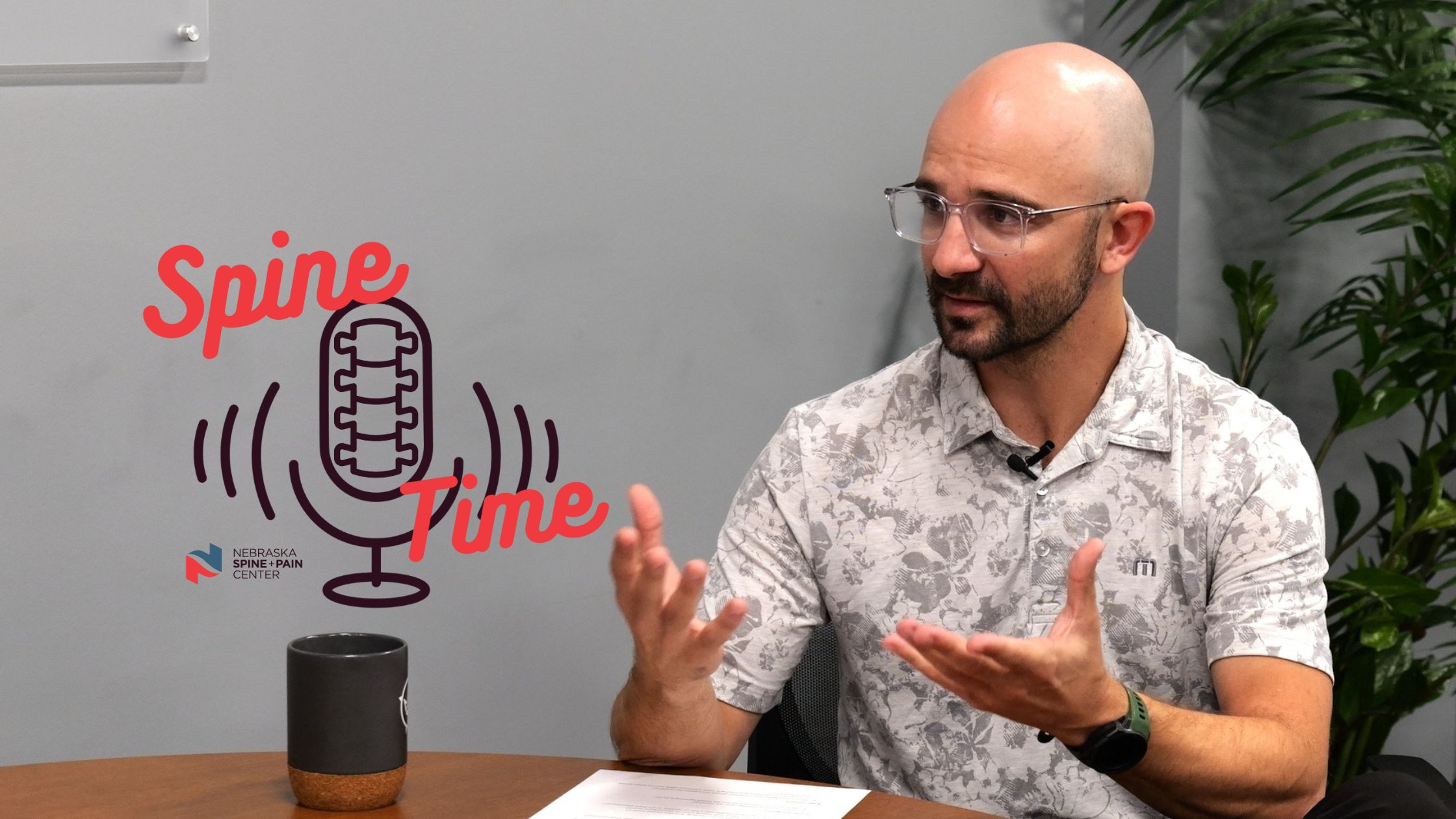
What is dry needling, and could it help your back, neck, or muscle pain? In this episode of Spine Time, we sit down with physical therapist Brett James to break down one of the most common questions patients ask.
Brett explains how dry needling works, how it differs from acupuncture, which conditions it can help with, and what to expect during and after a session, including soreness, bruising, and how long treatment takes. He also shares why it’s a tool to help you move and feel better rather than a standalone fix, and how to ask your care team about adding it to your treatment plan.
You can watch the interview on our YouTube channel, or listen along on Spotify or Apple Podcasts.
Episode Transcript
Zach
Hello, everybody, and welcome back to Spine Time. Nebraska Spine + Pain Center’s podcast, where we discuss everything about the back, neck, and spine with some of Nebraska’s best healthcare professionals. And in today’s episode, I’m joined by Brett James, who’s going to tell us a little bit about dry needling, which is something we do here at Nebraska Spine and Pain Center. So, without further ado, Brett, why don’t you introduce yourself, and we can kind of jump into what dry needling is?
Brett James, PT, DPT
Well, thanks, Zach, for having me on. My name is Brett. Um, I’ve been here at Nebraska Spine for about two years now. I’ve been in physical therapy for six. I’m from central Nebraska originally and just enjoy helping people, and I’ve been doing some dry needling for about four years. And recently we started it up here, and it’s been going pretty well, and we’re seeing a lot of patients get good effects from it. And it’ll be, I think, a good podcast where we can talk about what its effects are and maybe teach some people who can benefit and maybe learn a little bit more about it.
Zach
Awesome! Yeah – So I guess to kick things off right at the top, what exactly is dry needling? I know I’ve talked with people here in town about it a little bit, and there’s been a little bit of confusion around what that even is. So, can you just kind of explain what the procedure is like?
Brett James, PT, DPT
Dry needling is something that, we use a monofilament needle. So, there can be various sizes depending on the target tissue you’re trying to get to. So, it probably makes sense that your forearm wouldn’t need as big a needle as maybe your thigh muscle – that’s just based on the size of the tissue, but it’s called dry needling because it’s a dry needle. It’s a monofilament needle, a very flexible, thin needle that we use to poke into the skin. That kind of creates a micro-injury, so to speak. And then from that, there’s a lot of things that go on. Whether it’s increasing microcirculation, releasing tension on the muscle, or helping calm down natural pain hormones and creating our natural pain relievers into the area. Its target effect is kind of – what I tell patients is it’s kind of like a toilet flush. We’re trying to get rid of the crap that we don’t want and then bring in new things so that the body can heal quicker and faster and make our sessions more effective.
Zach
I guess just to clear the air, it is different from acupuncture, right? I know a lot of people think that immediately when they just think of needles on the body.
Brett James, PT, DPT
Yeah, I think that gets asked quite a bit. I mean, they’re both needles, but it’s more a difference in theory. Acupuncture is an Eastern type of medicine practice versus dry needling is a Western practice. So it’s a lot more research-based. Acupuncture is more of the theory that your body has natural energy. They do a lot more small needles that are localized to an area. I guess in some ways it’s similar; you’re trying to help the patient, but its mechanism and theory of how they actually work are quite a bit different. And how we use them is quite a bit different too.
Zach
What are some of the common conditions or situations where you’d want to use dry needling? What is it trying to treat?
Brett James, PT, DPT
So, if it’s been referred to me or if I’m thinking about using it with a patient, it’s usually on someone in pain, right? But it’s not always the first thing that jumps to our head. It’s not “oh, yeah, we need a dry needle, everyone.” Because if it were that way, needling would fix everyone. But I would say anyone with muscular tension or just general, irritation in the area, it can be helpful for neurological symptoms, what we call radicular symptoms, going down the arm. There’s some really sound research that needling can actually have an impact on hot spots or heat waves that are going down any kind of a hot nerve. But if you’re stiff in your neck and you’ve got to tight up a trap, that’s where needling works pretty well. And there’s a lot of good ways of testing and retesting to see if your treatment was effective. People have low back pain, and they’re stiff. That’s a good time to try some dry needling. So, there’s a lot of different ways we can needle, but there’s a lot of ways of testing to see if your results were effective too.
Zach
Is this a process that almost any physical therapist could do? Or is this something that you need specific training and certification to perform?
Brett James, PT, DPT
Good question. You can get dry needling certified in school, but it’s still newish. It’s been used for a while, but it’s still coming more about. So, a lot of your new grads are not coming out with dry needling certifications. There are different types of levels depending on the courses you go through or whoever. I’m dry needling certified, level one. I spent a twenty-hour course on needling. It was an extra course that I had to do after getting my physical therapy doctorate.
Zach
So, walk me through a typical dry needling process. Let’s say I came in for an appointment today. What would happen? From the moment I walked in, to the moment I walk out?
Brett James, PT, DPT
Let’s just say that you came in with some low back pain. You’ve been trying some exercises for a little bit, and you’re still having pain. I’m like, “Well, I could explain the benefits of dry needling.” I usually kind of explain, like I said, it’s like that toilet flush effect where we can use this tool, a needle, to kind of probe an area and create a little injury that can help flush away those painful hormones and bring in new circulation and calm down the muscular tension that should help our session out. A session looks pretty short. It’s not like we’re getting needled for thirty minutes, usually. It’s something that we do for five to ten to fifteen minutes to make the session go better so we can get into exercise and that can feel better. So, if I was needling your low back, most of my patients for low back will lie prone; they’re going to be lying on their belly, and we’ll clean the area with some alcohol, and it’s very safe. There’s a very low risk of any infection, but we still clean the area and the needling itself. It’s such a small needle that a lot of times I’ll tell people you’ll feel a little poke and maybe some pressure, but that needle pressure, when we put the needle in, usually they feel more the cap than they actually do the needle. I’m not a huge fan of going to the doctor and getting poked and getting my vaccines and things like that. But it’s a smaller needle. I would say it’s not quite as painful as that, but most of the time my patients will talk about the pressure, especially if they’re tight. A lot of times that’s what we’re trying to needle is because we’re trying to calm down any kind of like guarding or stiffness and things like that. If I’m doing your low back, I’ll just say for me, honestly, I do like a lot of like L3 through S1. So, I’ll go L3, four segments. We’ll needle through that, and I’ll explain the anatomy here in a bit. But then we’ll go L4, L5, and then L5 to S1. We’re trying to kind of go between the transverse processes and go into the small muscles that you have between there and create a targeted effect towards those areas that we can’t get to with our hands. And that’s something I also tell my patients: needling is like – I can rub your skin, but I can’t get to your deep tissues. Needling is a way that we can actually get to things that are deeper, like muscles that are harder to get to, so to speak.
Zach
Now, you mentioned micro-injuries, which is the technical term for stimulating stuff like that. But when you say injuries, what’s our pain level we’re expecting for something like this?
Brett James, PT, DPT
You know, pain levels are tough because they’re kind of different from person to person. I haven’t had a patient who has disliked it too much. A lot of that probably goes into how comfortable someone feels going into it. If they are, I would say in general speaking, it goes pretty well. If someone doesn’t like needles or they don’t want to, that’s when I don’t use it. If someone says I don’t like needles, I would say that’s a reason to not offer the treatment to that person.
Zach
So yeah, it’s completely optional. It’s not like something we’re going to force patients to do. It’s another treatment avenue if they’re looking for relief.
Brett James, PT, DPT
Yeah. Yeah. Something I think educating on it – and I try to educate on it and then see if people are interested in it. If they’re interested in it, then I’ll go with it. And if they’re not interested in it, then we have other ways of helping people, including soft tissue techniques, traction, and cupping. There’s a lot of different hands-on manual therapy techniques. Dry needling is just a pretty sound, research-based intervention from a manual therapy perspective that I would say you probably get a little bit better effect than you would from, like, soft tissue or other things like that. But there’s a lot of different ways that we can help people with our hands. It’s a nice tool to have in your toolkit, so to speak.
Zach
How long does a session usually take of dry needling? How, I guess, in the grand scheme of your whole appointment, how long does it usually take to do a section like you mentioned, lower back earlier? Let’s use that as an example. How long is the patient going to be lying down prone during that process?
Brett James, PT, DPT
We see a lot of patients for thirty minutes. I would say your session of dry needling is probably going to be anywhere from like ten minutes or less. It depends on some things, like if it feels really good and sometimes, we’ll sit there and we can do some just some gentle movement with it. And then it kind of helps create the responses that we’re looking for, too. But most of the time I’d say that I’m doing it, I’m using it in the beginning of my session. And then after that, we’ll probably spend the last fifteen to twenty minutes doing exercises and some strengthening and just general movements.
Zach
Is there any soreness to kind of be expected after the needling? I know during the process there might be some minor discomfort for large gain, but what are you looking at on the ride home?
Brett James, PT, DPT
So, for some people, it depends because soreness can increase after needling; that’s one of the things we kind of talked about – afterwards, you might have an increase in symptoms for a short period of time. Bruising, bleeding, – if you hit a capillary or things like that when you’re needling, can happen. Again, it kind of sounds like a silly thing that we say in PT, but it kind of depends per person. Some people, I will tell you, I’ve had people who have immediate relief, and they love it so much that when they come back, they want needled. That’s like the first thing they’re asking for. And then you’ll have people who come back, “I was sore for a day, but then I felt really good for the next four to five days. And it made my exercises easier.” So, you get a little bit of both. But in general, I feel like in some ways, if it doesn’t help and we tried it, let’s try something different this time. It’s kind of like a test-retest method: either you can check range of motion or just check their subjective pain response and see how they feel. And that kind of helps guide you on whether or not you want to continue to use it for your patient.
Zach
What’s a question that you might want patients to ask you before having dry needling done? Or maybe something you wish got asked more before doing dry needling?
Brett James, PT, DPT
I kind of like blunt questions because I like giving third-grade responses because I think when you understand something, it makes it easier. “Is this going to fix it?” I love that because I’d be like, “No! But it’s going to help you.” I think this is a good tool to help people. When you’re rehabbing, we’re managing things. We’re trying to give you tools to help manage your symptoms. And I think dry needling can be an effective tool and help manage it. People go to the chiropractor once a month and get nipped or popped, right? It’s kind of similar to that in some ways where it’s a tool that we can help use to help calm down the area that might help make movement get easier when you get sticky. And it’s like you get stuck in places, or it gets painful. But its design wasn’t to actually fix things. It’s just supposed to help improve that area of treatment or the area of target or whatever is going on that we’re trying to help. It’s supposed to help make that move better and feel easier to do that.
Zach
Thank you so much for coming on the show today, Brett. I know dry needling is a really fascinating topic. We get asked about it by patients all the time. So, I hope this helps clear up some of the confusion and provides clarity for our patients. I know I learned a ton about it. I think it’s a really good thing that we offer to our patients and is just another part of kind of the comprehensive care that we offer here at Nebraska Spine and Pain Center. So, I guess the last thing I have to ask you is, how can a patient set up an appointment for dry needling?
Brett James, PT, DPT
I think the biggest thing is just to ask, and if you’re getting referred, if you’re talking to your doctor and they’re sending you to physical therapy, ask about it. Because we, me and my colleague Jorre, are doing it here. That’s what I think today was supposed to help – to give good information. And then so people feel like they have an idea of what can PTs do for me? And like I said, there’s a lot of different ways we can help people, but dry needling is a good tool for a lot of a lot of patients. Just asking should help start your treatment and maybe be part of your treatment plan.
Zach
Thank you so much again, Brett, for taking the time to do this today. And thank you, our viewer for tuning in to this episode of Spine Time. You can find this episode and previous episodes of our show on our YouTube channel, Spotify and Apple Podcasts, and we will see you in the next one. Bye!