
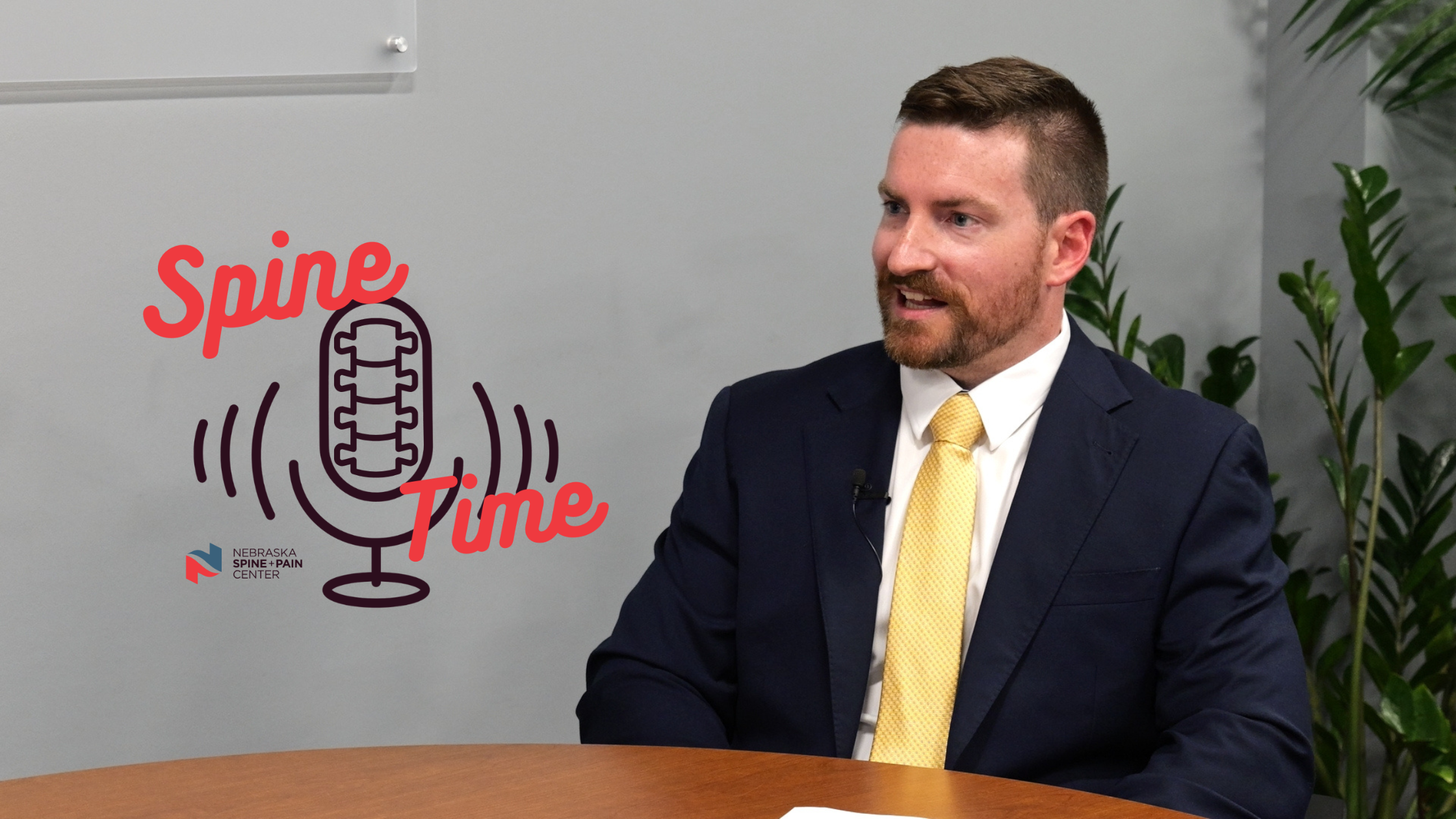
In this episode of Spine Time, we sit down with Dr. Ryder Reed, Nebraska Spine + Pain Center’s newest orthopedic spine surgeon, for a wide-ranging introduction. Dr. Reed shares his journey, from growing up around his family’s powersport dealerships to the mentor who first nudged him toward medicine, what drew him to orthopedics and spine surgery, and his patient-first philosophy, built on clear communication and understanding each person’s goals.
Tune in to get a glimpse of Dr. Reed inside and outside the clinic. You can watch the interview on our YouTube channel, or listen along on Spotify or Apple Podcasts.
Episode Transcript
Zach
Hello everybody, and welcome back to Spine Time, Nebraska Spine + Pain Center’s podcast, where we discuss everything about the back, neck, and spine with some of Nebraska’s best healthcare professionals. And today, I have the honor of being joined by our new incoming physician, Dr. Ryder Reed. Thank you for joining us today.
Dr. Ryder Reed
No, thank you for having me. It’s a pleasure.
Zach
It’s so nice to have you here. Thank you so much for coming in. Everybody’s so excited to have you on the team, but I thought it would be great for us to get together and kind of have an opportunity for you to introduce yourself to our patients and potential patients, and just get to know you a little bit better.
Dr. Ryder Reed
No, absolutely. Happy to talk about it, happy to be here, happy to be part of the team.
Zach
I guess to kick things off, let’s just start off with where did you grow up?
Dr. Ryder Reed
Yeah, absolutely. So my folks were powersport dealership owners, and so they initially had a dealership in South Sioux City, Nebraska. They had that for about 10 years before they ended up starting a new location in Southwest Minnesota, a town called Luverne, and so that’s where I did my high school years and everything like that. So from there I went just a quick trip west to Sioux Falls, South Dakota, where I went to Augustana University. I majored in biology and Spanish there, before I got accepted to Creighton University here in Omaha, Nebraska. And that’s really when I kind of had my first glimpse into the area and really kind of fell in love with it. And, you know, we made a lot of connections here. And through the mentorship I received here, I ended up going to the Mayo Clinic for my orthopedic surgery residency. Spent five years there, and then I made it into one of the nation’s top spine fellowships in Louisville, Kentucky. Just finished up a year there, and now we’re here ready to start the practice.
Zach
So growing up in South Sioux City, what was your family like, kind of your early life there?
Dr. Ryder Reed
Yeah, absolutely. It was, you know, it’s me and my mom. I’m an only child, and so I got a lot of attention that way, but really, you know, they were business owners, and so in a way, I ended up growing up around that business too, and I got to spend time with them and see how they interacted with the people of Nebraska and people of all walks of life; the farmer whose four-wheeler doesn’t work, the businessman who likes to go out on his motorcycle for the weekends. And I kind of got to understand an appreciation of the people of Nebraska, and everybody was happy to be here, happy to do business, happy to be involved, right? I just really fell in love with it from an early age.
Zach
Which side of South Sioux City did you grow up on? Was it the Nebraska side, the Iowa side?
Dr. Ryder Reed
Yeah. So it was the Nebraska side. And I know a lot of people would say it’s barely Nebraska, but don’t tell the people that live there that. They are diehard Nebraskans, for sure.
Zach
How did you get into the world of medicine? When did you decide that you wanted to become a doctor?
Dr. Ryder Reed
Yeah. I don’t really know, you know? And I think it was a series of small steps. There’s one moment that stuck out in my mind, like I had mentioned, neither of my parents were in medicine. Neither of them actually graduated from college. And I was on the football field in high school one day, and we had a coach, Dr. Josh Crabtree was his name. He’s a family physician. He had played college football and helped out when he could coaching the high school team. And we had finished up practice one day, and he asked, “What are you doing with your life, Ryder?” And I said, “To be honest, sir, I’m not really sure.” And he said, “You ever thought about being a doctor?” And I said, “Well, no.” You know? That’s not something people normally think about. And he said, “Well, you should consider it. I think you have some of the characteristics that you’d be a good doctor someday.” And I kind of took that to heart. I did some self-reflection. And yeah, when I showed up to college, a year later at that point, I announced my major as biology with an intention to go to medical school someday.
Zach
Starting out in biology, what ultimately pulled you towards orthopedics and spine specifically?
Dr. Ryder Reed
You know, once I had made it to medical school and I started interacting with the different subspecialties, it was pretty early on. I actually applied to do a research grant through the Department of Orthopedics. You know, growing up with my parents in powersports, I always was tinkering on something. It was kind of a natural next step for me to experience that since much of orthopedics is working with your hands, thinking about the way things work mechanically. And then certainly, when necessary, we need to use instrumentation in order to do a successful surgery, right? I actually had applied to do a research grant with Dr. McClellan here actually, and that was kind of my first foray into the practice, as well as the field. And the way that he took care of patients, the patients that came in, with pretty limiting issues, a lot of pain, a lot of disability, and the way he took care of them, not only helping them, but the relationship that they formed, I thought that that was a sacred thing. And I thought that that was a career worth pursuing. It’s something that would bring me quite a bit of fulfillment. And throughout my training I’ve found that to be true.
Zach
You’re new to the Omaha, Nebraska area. What do you think of the city so far?
Dr. Ryder Reed
Oh, I mean, it’s excellent, right? I have two small kids. I have a four-year-old and a two-year-old, and they had the animatronic dinosaurs at Lauritzen Gardens last weekend, and so we took them there. It was fantastic. It was a little bit of a hike, but you know, we got our exercise in. And then my wife is already planning on getting season passes to the Omaha Zoo. It’s a lovely area. Everybody from the person at the gas station to the person at the grocery store, to everybody I’ve had the pleasure of interacting with here, everybody’s just been a delight, and I’m really reaffirmed in my decision to put my family back in Omaha, Nebraska. It’s fantastic.
Zach
Talking about you and your practice and how you would run a clinic, how would you describe the way you interact with patients?
Dr. Ryder Reed
Yeah, I think there’s a lot of different aspects of it, but if we’re going to talk about one thing, I think communication is the key. And if you don’t have good communication with the patients, I think the rest of it is going to be hard to overcome. I think breaking that down into a few areas is important. The first is making sure I understand their problem, right? And so one of the first things I like to ask a patient when they come in the door is, “How can I help you?” That can be very telling as to what they actually made the appointment for. And then first and foremost, that’s the thing that I want to address for that day’s visit: the answer to the question, “How can I help you?” A lot of times, I’m familiar with the patients and I know where we’re headed, but I like to make sure that I’m hearing them out every single time they come to office. After that, I like to make sure that they have an understanding of their condition. What are the things that they’re describing? Is that something that we see relatively commonly, or is it something a little bit less common that we see? Make sure they understand their imaging. And with that too, I think that’s where part of my upbringing with my family and watching how my parents interacted with people of different backgrounds. If I start explaining mechanical engineering to a farmer, they may not understand. But if I make metaphors or similes and things like that, my goal is to get them to understand first and foremost. And once they understand their condition, then we can start talking about the next options and what’s in line with their goals. If somebody says, “Well, my goal is to get back to doing yoga,” that puts things in my head with, “Okay, well, these are the options that I think are going to best achieve that,” Versus, “My goal is to be able to stand long enough that I can walk my daughter down the wedding aisle,” Not the same goal, right? Then we can talk about the best option to go forward. But I think it really begins with just open communication and making sure that we’re crossing all those bridges in a timely fashion.
Zach
So outside of Dr. Ryder Reed, who is Ryder Reed the person? What’s something that you like to do to unwind or relax after a long day of helping patients?
Dr. Ryder Reed
I like to tell people I have the two most sacred titles in the world. I get to be a doctor and I get to be a father and a husband. And so outside of work, with two small kids, we are pretty busy all the time, kind of chasing them around. They’re at the age where they’re starting to discover sports, and so I’m trying not to bias them towards any one thing or the other. (football.) But we’ll get there eventually. And then with my wife too, we like to stay active. We like to go out and do things. We’ve been walking a lot more. Otherwise going to the gym. To get there though, my wife has to kind of pry me out of the garage. During COVID actually, when a lot of the hospitals were closed down, we were left with a little bit of time on our hands, and I picked up woodworking as a hobby. And so I bought quite a few things that kind of got me into that, a planer, some joiners, router, that sort of thing. And with a new place here in Omaha, there’s definitely some home projects I’m enjoying picking my way through too.
Zach
Oh, yeah, I can imagine. New house, you’ve probably got a ton of things planned already.
Dr. Ryder Reed
Oh, that’s right. Yeah, the honey-do list is growing by the minute. But it’s exciting. And also getting to do it with my kids, right? I think everybody can remember some memories from their upbringing, but some of my fondest memories was doing stuff like that with my dad. And having the opportunity to do that with my kids here is fantastic.
Zach
Do you have potentially a special interest or a hobby that might surprise people when they first meet you?
Dr. Ryder Reed
Yeah, it’s a little bit of an oxymoron. In medical school actually, while I was here in Omaha, I wanted to do something to form more healthy habits, and I started going to the gym more often. And I discovered the sport of powerlifting, which, for people that aren’t familiar, it’s just squat, bench, and deadlift. You get three tries at each. There are judges that say you went deep enough, you did a complete rep or not. And I got into that, and I actually ended up doing quite well at it, up into medical school. Certainly that sport has, I think, an expiration date to it. And certainly as your priorities in life change, so too should your hobbies, right? And so I’ve kind of left that in the rear view. But yeah, that was kind of a fun thing and a little bit of an oxymoron to talk about a spine surgeon who used to deadlift, right?
Zach
So to wrap up today’s interview, what are you most excited about starting this role and joining the team here at Nebraska Spine + Pain Center?
Dr. Ryder Reed
My family and I, we’re just ecstatic to be back in the area. I love seeing people that are happy to come to work every day. I love taking care of the people from this part of the world. And it really is just, I just get along with people here, and I really am happy to be part of the team. Picture whatever sports team you dreamed of playing for as a kid, that’s what I get to do now here at this place with these people. And so I’m just ecstatic to be here and take good care of the patients in this part of the world.
Zach
Well, thank you so much for joining us today, Dr. Reed. Like I said at the top of the episode, everybody’s super excited to have you here. People haven’t been able to stop talking about it. And I think you’re going to add so much to the practice and be able to help so many more patients here in Omaha and the surrounding areas. And I want to thank you, our viewer or listener, for tuning into today’s episode. You can find future and previous episodes of Spine Time on our YouTube channel, Spotify, or Apple Podcasts. And I want to say it’s been a pleasure, and we’ll see you in the next one. Thank you.